


News

Published on
24 June 2026
Updated on
24 June 2026
ENDURE general assembly on 17.06.2026
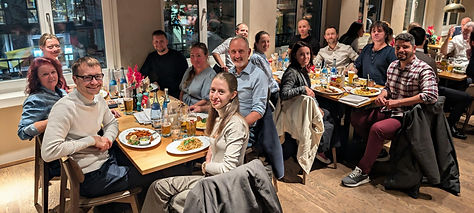
The General Assembly gathered I+D leaders at the Aragon Hydrogen Foundation on 17.06.2026 to coordinate advanced cell development and life cycle sustainability. The deployment of the green hydrogen economy in Europe demands not only ambition but millimetric technical precision. With this purpose, partners of the European consortium ENDURE gathered at the Aragon Hydrogen Foundation headquarters to hold their General Assembly, a key face-to-face meeting that served to synchronise the gears of research aimed at maximising the durability and efficiency of current electrolysis systems.
During the working sessions, the partners engaged in a deeply enriching technical exchange. The day structured the debate around the core Work Packages of the project, spanning from laboratory-scale materials science to market viability and the end-of-life of components.
We thank Vanesa Gil, Lidia Martínez and Carla Ochoa for the great organisation of this event and we look forward to the final six months of the ENDURE timeline.
Read the full article from our Download Center!

Published on
20 May 2026
Updated on
20 May 2026
The ENDURE 2-year retrospective is out!
In our second press release, we are reflecting on 2 years of scientific and technical achievements, and looking forward to the current year, where the technologies developed within ENDURE are put to the test in various industrial-scale setups.
Check the full document on our download center!

Published on
20 March 2026
Updated on
20 March 2026
ENDURE at the EHEC 2026 conference
Last week at the European Hydrogen Energy Conference 2026 (EHEC), Nicolás van Dijk gave a talk entitled "Experimental validation of a 10kW alkaline stack by ENDURE harmonized testing protocols".
The baseline 10kW stack - built by Stargate Hydrogen and tested at Fundación Hidrógeno Aragón - is the backbone of stack development within ENDURE. The first work package closes with its investigations and sets the mark for current stack testing and development. Key insights from this study include:
Successful stack testing campaign with protocols developed within ENDURE.
Assessment of operating window of the test bench.
No permanent degradation observed after 573h of operation and 45 ON-OFF cycles.
Cell-by-cell EIS analysis.

Published on
5 March 2026
Updated on
6 March 2026
ZSW Sets New Standards: Boosting life time and reliability with ASTs for Alkaline Electrolysis
Improving the durability of hydrogen generation is key to scaling up a sustainable energy future. Within the ENDURE project the Centre for Solar Energy and Hydrogen Research Baden-Württemberg (ZSW) has now developed a framework for accelerated stress tests (ASTs) for alkaline electrolysis electrodes – based on the findings of reports JRC133726 and JRC122565 from the Joint Research Centre.
In the future, AST investigations should provide information about the long-term behavior of electrodes by accelerating degradation processes representative of real operation. Therefore, AST protocols are to be designed to simulate these processes by systematically applying defined stressor types in a controlled and separated manner. As a first step, ZSW developed 14 single-cell AST protocols addressing the following stress categories:
Dynamic load
Excessive load
Repetitive on–off cycling
Reverse currents
Electrolyte impurities
All protocols are described in detail in our report, which is published on our project homepage. These AST-protocols are intended to support a harmonized and reproducible approach to durability testing in alkaline electrolysis. The protocols now need to be experimentally validated. First results, applying a Raney nickel cathode in a half cell, indicate that excessive current densities above 2 A cm⁻² and reverse-current operation lead to pronounced electrode degradation.
Altogether, the developed protocols represent an important step toward more consistent and comparable durability testing in alkaline electrolysis.

Published on
3 March 2026
Updated on
3 March 2026
Don't miss the last ENDURE publication!
An important paper is out for the ENDURE consortium: Anna Müller from IFAM Dresden conducted this study on highly active coatings for alkaline electrolysis.
Summary:
In our recent paper, we demonstrate a highly active Ni–Mo catalyst for alkaline HER (−89 mV at −1 A cm⁻²) and show that the true active phase consists of Ni-rich Ni₁₀Mo nanoparticles anchored on MoO₂ rather than the frequently assumed Ni₄Mo phase. By clarifying the active species and the role of the Ni₁₀Mo/MoO₂ interface, this work provides valuable insights into the design of efficient, PGM-free cathodes for alkaline water electrolysis under industrial conditions. This improved understanding of the structure–property relationship is essential for scaling up non-PGM catalysts for AEL and enable the transfer of this concept to related technologies such as AEM water electrolysis and, potentially, beyond.
This paper can be direclty downloaded from our website.

Published on
19 December 2025
Updated on
19 December 2025
ENDURE is on the European Commission's Innovation Radar!
Good news for the ENDURE project: two of our innovations have been detected by the European Commission Innovation Radar!
The first innovation is literally at the core of the alkaline electrolysis technology:
🔹Innovation Title: High-Performance, Durable, Zero-Gap Alkaline Stack Design for Cost-Competitive Green Hydrogen Production.
🔹Market Maturity of the Innovation: Tech Ready.
🔹Market Creation Potential of the innovation: Noteworthy.
🔹Key Innovators: Stargate Hydrogen, Université catholique de Louvain and Fraunhofer IFAM Dresden.
The second innovation brings the necessary modeling tools for advanced cell and stack design:
🔹Innovation Title: Validated multi-level CFD modelling coupled with advanced X-ray tomography for electrolyser cell- and stack-level optimisation.
🔹Market Maturity of the Innovation: Exploring.
🔹Market Creation Potential of the innovation: High.
🔹Key Innovators: Stargate Hydrogen and Université catholique de Louvain.
This information will soon be accessible on the European Commission's Innovation Radar platform.
Published on
10 October 2025
Updated on
10 October 2025
ENDURE general assembly on 09-10.09.25
Here ends another crazy week for the ENDURE consortium: after our positive online mid-term review on Tuesday with the European Commission, we gathered together in Stuttgart at ZSW for another of our special 2-day general assembly marathons on Thursday and Friday.
In short – and although not much about this gathering can really be called short – nothing could stop our technical discussions. Neither the coffee breaks, the lunch breaks, the toilet breaks, the local lab tour, the common dinner and the short walks in between those events; nor the management, dissemination and communication discussions, which had to be postponed to our regular online meetings.
The electrode development team is wrapping up its most promising candidates and preparing its first scientific publication drafts. The electrodes developed in the first half of ENDURE are already being tested in their upscaled versions in various types of demonstrators, while the baseline stack is running and the design of the prototype stack is undergoing subtle refinements; all of these elements converging towards intensification of alkaline electrolysis on a term that could not possibly be made shorter.
Thank you, Ben Haugk and Tobias Ludwig, for your warm welcome and the perfect organization of this assembly. Soon, the ENDURE project will enter its final year, and given how much energy we have put so far in our developments, we can safely assume that we have not seen yet all the fruits of our work.

Published on
22 August 2025
Updated on
22 August 2025
ENDURE at the ICE 2025 conference
ENDURE will be well represented next week at the ICE 2025 conference in Freiburg. Two posters and one talk, all of them will take place on the first day, Monday 25.08.25.
First, during the AEL: Catalysts and Electrodes session at 11:20, Anna Katharina Müller will present her talk: “Ni-Mo nanoparticles supported on MoO2 as highly active electrocatalyst for hydrogen production in alkaline water electrolysis”, highlighting electrode development advances within the project.
Then, during the poster session between 15:20 and 16:50, feel free to pass by our posters! Lidia Martínez Izquierdo will answer your questions about the “Validation of ENDURE testing protocols using a 10 kW baseline stack with Ni foam electrodes”, a crucial step towards the upscaling of the technology developed at the electrode level.
And during the same poster session, Renaud Delmelle will discuss the “Interplay between structure and electrocatalytic activity in flow-engineered three-dimensional porous transport electrodes for alkaline electrolysis”, focusing on novel electrode structures for efficient bubble evacuation.
See you there!

Published on
13 June 2025
Updated on
27 August 2025
ENDURE project showcased at the museum!
UCLouvain celebrates its 600th anniversary with a very special exhibition at the Musée L in Louvain-la-Neuve. The exhibition is called Happy U! and lasts from 05.06.2025 to 22.02.2026. That’s plenty of time to pass by!
The exhibition is structured as a flat, with the lounge dedicated to personalities who left their mark on the university, the corridor tracing the key steps of its evolution, the library revealing its hidden treasures and the terrace debating major issues faced by researchers today.
Actually, I forgot to mention one room here: the kitchen, where visitors are invited to have a look behind the scenes of modern research, following concrete examples of current (running) research projects. We are proud to announce that ENDURE is among the showcased projects (click HERE!)
More information about the Happy U! exhibition HERE.
More information about the intergration of ENDURE in the exhibition HERE.

Published on
4 June 2025
Updated on
4 June 2025
ENDURE presentation at the World Hydrogen Summit & Exhibition
This year at the World Hydrogen Summit & Exhibition in Rotterdam, Rainer Küngas — CTO and co-founder of Stargate Hydrogen — presented the ENDURE project, focusing on its current scientific and technical challenges.
The ENDURE team is developing new 3D-structured porous transport electrodes (PTEs) to boost how efficiently electrolysers operate. These improvements help both the chemical reactions and the flow of gaseous products inside the electrolyser. It is only though optimizing this interplay between PTE structure and electrochemical activity that substantial intensification is possible in alkaline electrolysis, notably without the use of platinum-group metals. In the ENDURE project, performance is pushed together with durability.
Such complex electrodes are designed with the help of numerical tools: computational fluid dynamics (CFD) comes not only as a standard backup for experimental data, but as predictive tool for electrode design.
Watch the presentation using the link HERE, and check the slides of the presentation in our download center!